
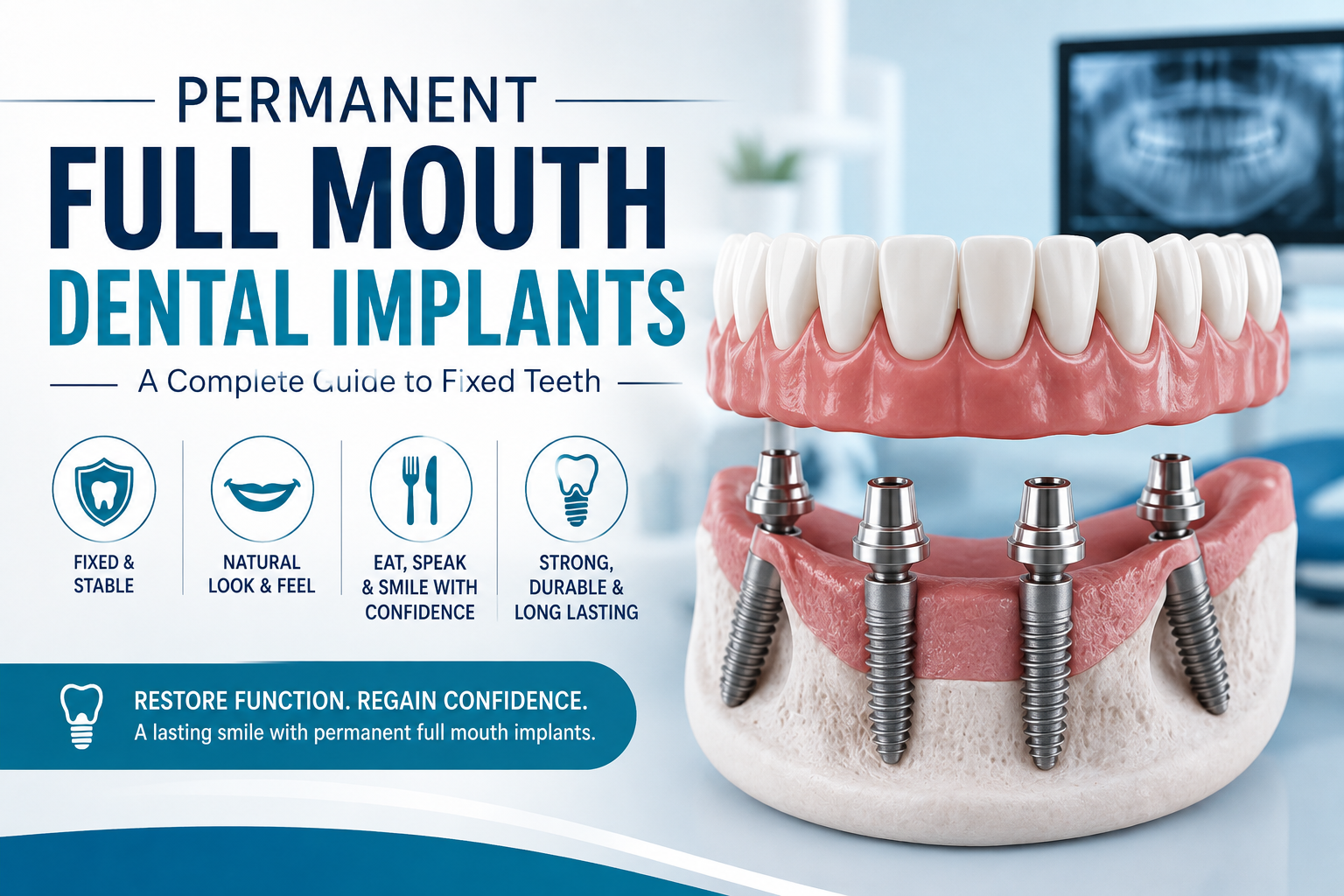
Losing most or all of your natural teeth can affect much more than your smile. It can make chewing difficult, change speech, affect confidence, and influence the way you enjoy everyday meals. Modern implant dentistry offers a stable way to rebuild a complete smile. Permanent full mouth dental implants can replace missing teeth with a fixed restoration supported by dental implants, giving patients a more secure alternative to conventional removable dentures for long-term oral health support.
This guide explains how the treatment works, who may benefit, what the process involves, and why choosing an experienced dental care team matters.
What Are Permanent Full Mouth Dental Implants?
Permanent full mouth dental implants are a fixed tooth-replacement solution for people who have lost many or all of their teeth. Instead of placing an individual implant for every missing tooth, a carefully planned number of implants can support a complete arch of replacement teeth.
The implants act as artificial tooth roots. After they are placed in the jawbone and become stable, they support a customized fixed bridge or full-arch prosthesis. The final teeth are designed to restore chewing function, appearance, and a more natural feeling when compared with loose removable dentures.
The exact number and position of implants depend on factors such as bone volume, gum health, bite, overall oral condition, and the type of restoration selected. A dentist must evaluate these factors before recommending treatment.
Who May Need Full Mouth Implant Rehabilitation?
This treatment may be considered for adults who have lost most or all of their teeth or whose remaining teeth have a poor long-term prognosis. They may also be an option for people who struggle with loose dentures, difficulty chewing, or repeated dental problems.
However, implants are not automatically suitable for everyone. The dentist needs to assess the gums, jawbone, existing teeth, medical history, oral hygiene, and treatment expectations. Some patients may need gum treatment, tooth extraction, or bone-related procedures before implant placement.
How Do Full Mouth Dental Implants Work?
The process begins with a detailed consultation and examination. The dental team evaluates the condition of the mouth and collects the diagnostic information needed to plan implant placement. Digital imaging can help the dentist understand the jawbone and important anatomical structures before surgery.
After planning, the dental implants are placed in selected areas of the jaw. During healing, the implants can integrate with the surrounding bone. This process, known as osseointegration, provides the foundation needed for a stable restoration.
Once healing and stability are appropriate, the final fixed teeth are designed and fitted. The dentist checks the bite, appearance, comfort, and function before completing the restoration.
Some cases may qualify for immediate or same-day provisional teeth. However, this depends on individual clinical conditions and should not be assumed for every patient.
Benefits of Permanent Full Mouth Dental Implants
Permanent full mouth dental implants can offer several advantages when patients are appropriately selected.
1. Improved Chewing Stability
A fixed implant-supported restoration is designed to remain securely in place. This can make eating more comfortable than wearing dentures that move during chewing.
2. A More Confident Smile
Replacement teeth can be customized for shape, size, and appearance. A carefully planned restoration can support a natural-looking smile while improving facial aesthetics.
3. No Routine Denture Removal
Unlike conventional removable dentures, a fixed implant-supported restoration is not designed to be taken out by the patient for everyday use.
4. Support for Oral Function
Replacing missing teeth can help restore important functions such as chewing and speaking. A balanced bite also matters for comfortable daily use.
5. Long-Term Treatment Potential
Implants are designed as a long-term tooth-replacement option. Their longevity depends on factors including oral hygiene, bone and gum health, implant maintenance, lifestyle habits, and regular professional reviews.
Permanent Implants vs Traditional Dentures
Traditional dentures rest on the gums and can be removed. Although they remain useful for many patients, some people experience movement, discomfort, difficulty chewing certain foods, or concerns about stability.
Permanent full mouth dental implants use implants anchored within the jaw to support a fixed restoration. This difference can provide greater stability for suitable patients.
However, implants involve surgery, healing, careful planning, and ongoing maintenance. Dentures may be simpler or more appropriate for certain individuals. The right choice depends on oral health, bone condition, expectations, budget, and the dentist’s clinical assessment.
The Permanent Full Mouth Dental Implant Treatment Process
A typical treatment journey can involve the following stages:
1. Consultation and Assessment
The dentist reviews your dental history, examines your gums and remaining teeth, and discusses your concerns and expectations.
2. Digital Diagnosis and Planning
Imaging and other diagnostic tools help assess bone structure and determine suitable implant positions. Indus Dental Care highlights the use of 3D digital imaging and guided implant planning as part of its implant care approach.
3. Preparatory Treatment
If required, damaged teeth may need extraction, gum disease may need treatment, or other procedures may be recommended before implant placement.
4. Implant Placement
The selected implants are surgically placed into the jawbone. Local anesthesia and appropriate comfort measures are used according to the procedure and patient needs.
5. Healing and Integration
The implants need time to stabilize and integrate with the surrounding bone. The dentist monitors healing before progressing to the definitive restoration.
6. Final Fixed Teeth
A customized full-arch restoration is fitted after the implants are ready. The dentist checks the bite, comfort, appearance, and function.
7. Maintenance
Regular dental reviews and professional cleaning help protect the implants, gums, and restoration over the long term.
Are Full Mouth Implants Painful?
Many patients worry about discomfort before implant treatment. The procedure itself is performed with anesthesia, so the surgical area is numbed during implant placement. Some soreness, swelling, or sensitivity can occur after treatment, but the dentist provides appropriate instructions for managing recovery.
At Indus Dental Care, patient comfort is an important part of its approach. The clinic describes painless injection systems and modern technology as part of its effort to make dental procedures more comfortable.
How Long Can Full Mouth Implants Last?
There is no single lifespan that applies to every implant patient. Good oral hygiene, regular dental check-ups, healthy gums, appropriate bite forces, and professional maintenance all influence long-term outcomes.
The implant itself and the visible restoration also have different maintenance considerations. Even when an implant remains stable, the prosthetic teeth may eventually require repair, adjustment, or replacement due to normal wear.
Why Choose Indus Dental Care for Full Mouth Implant Treatment?
Choosing the clinic is an important part of the treatment journey. Permanent full mouth dental implants require careful diagnosis, surgical planning, prosthetic design, and long-term follow-up. Indus Dental Care provides implant treatment alongside other dental specialties, allowing patients to receive comprehensive care.
The clinic states that it uses modern diagnostic and treatment technologies, including 3D imaging, intraoral scanning, computer-guided implant systems, and CAD/CAM technology. These tools can support accurate diagnosis, treatment planning, and customized restorations when used appropriately.
Indus Dental Care also emphasizes personalized treatment. Every patient has different bone conditions, gum health, dental history, aesthetic preferences, and functional needs. A customized plan can therefore be more appropriate than applying the same implant approach to every patient.
The clinic also highlights patient comfort, hygiene, and transparent communication. Before beginning treatment, patients should receive a clear explanation of the proposed procedure, expected timeline, possible alternatives, aftercare requirements, and estimated costs.
Is Full Mouth Implant Treatment Right for You?
Only a qualified dentist can determine whether implants are suitable for your specific condition. During your consultation, ask about your bone quality, gum health, remaining teeth, implant options, temporary teeth, healing period, final restoration, maintenance, and alternatives.
A good consultation should also give you enough information to make an informed decision without pressure. If you have existing medical conditions or take regular medication, tell your dental team before treatment so they can consider your individual needs.
FAQs
1. What are permanent full mouth dental implants?
Permanent full mouth dental implants are a fixed tooth-replacement solution where dental implants support a full arch of artificial teeth. They are designed to provide greater stability than conventional removable dentures.
2. Who is a suitable candidate for permanent full mouth dental implants?
Adults who have lost most or all of their teeth, have severely damaged teeth, or experience problems with loose dentures may be candidates. A dentist must evaluate bone health, gum condition, oral hygiene, and overall dental health before recommending treatment.
3. How long do permanent full mouth dental implants last?
Dental implants can provide long-term tooth replacement when properly maintained. Their longevity depends on factors such as oral hygiene, gum health, bone condition, lifestyle habits, and regular dental check-ups. The artificial teeth may require maintenance or replacement over time.
4. Are permanent full mouth dental implants painful?
The implant procedure is performed under anesthesia, so patients should not feel pain during surgery. Some swelling, soreness, or discomfort may occur during recovery. Your dentist will provide appropriate aftercare instructions to support healing.
5. Why choose Indus Dental Care for full mouth dental implants?
Indus Dental Care combines implant dentistry with modern diagnostic and treatment technologies, including 3D imaging and digital treatment planning. The dental team focuses on personalized treatment plans, patient comfort, and comprehensive follow-up to help patients make informed decisions about their oral health.
Conclusion
Permanent full mouth dental implants can provide a stable, fixed approach to replacing extensive tooth loss. They can improve chewing, support speech, restore smile aesthetics, and reduce the movement associated with conventional removable dentures for appropriately selected patients.
The success of treatment depends on much more than the implant itself. Accurate diagnosis, careful planning, healthy gums and bone, skilled placement, a well-designed restoration, and consistent maintenance all contribute to a better long-term outcome.
If you are considering permanent full mouth dental implants in Coimbatore, Indus Dental Care can help you understand your options through a personalized dental evaluation. With modern diagnostic technology, comprehensive dental services, and a patient-focused approach, the team can guide you through the treatment journey from assessment to restoration and follow-up.
Your first step is a professional consultation. Discuss your oral health, goals, available treatment options, and expected results with the dental team before deciding on the right solution for your smile.